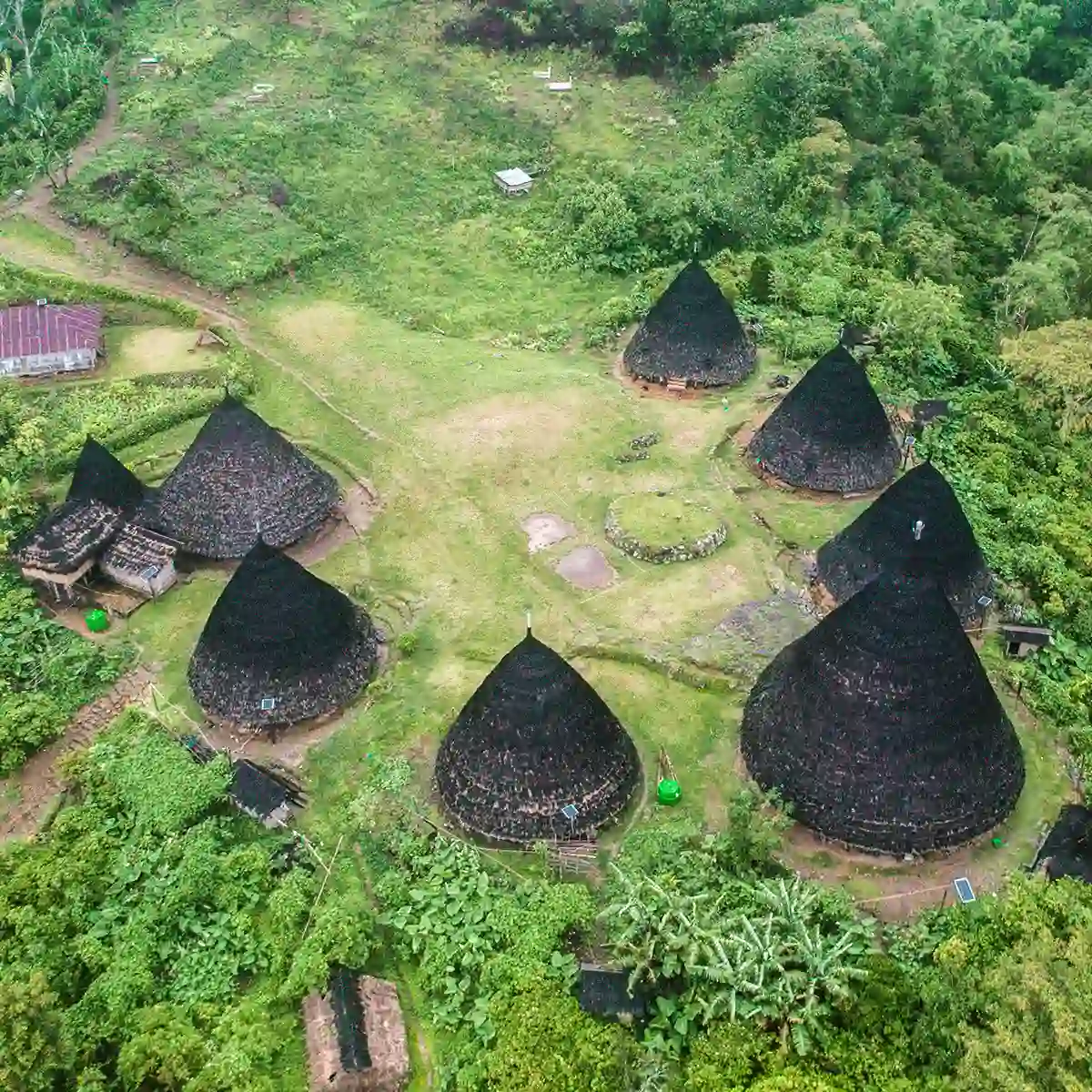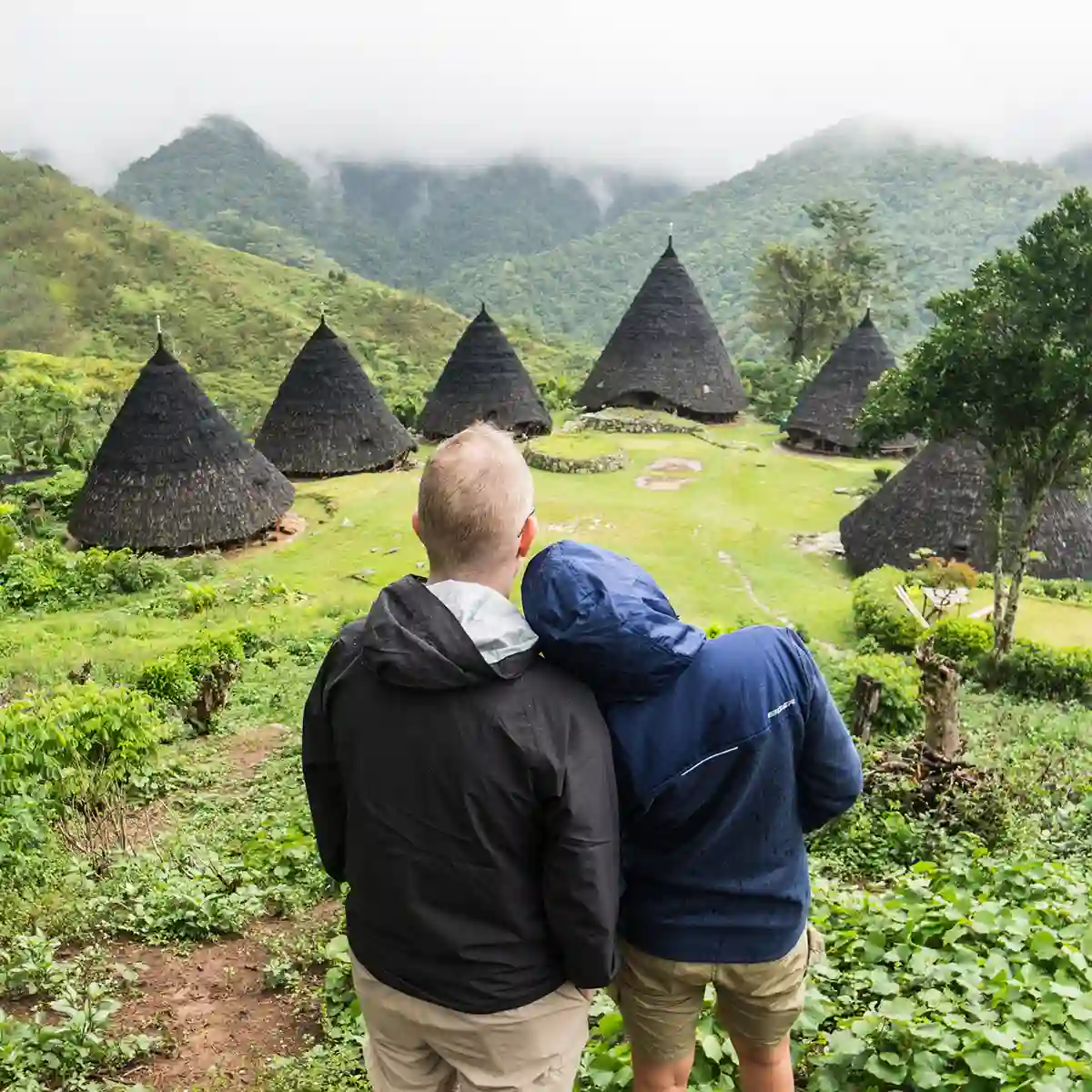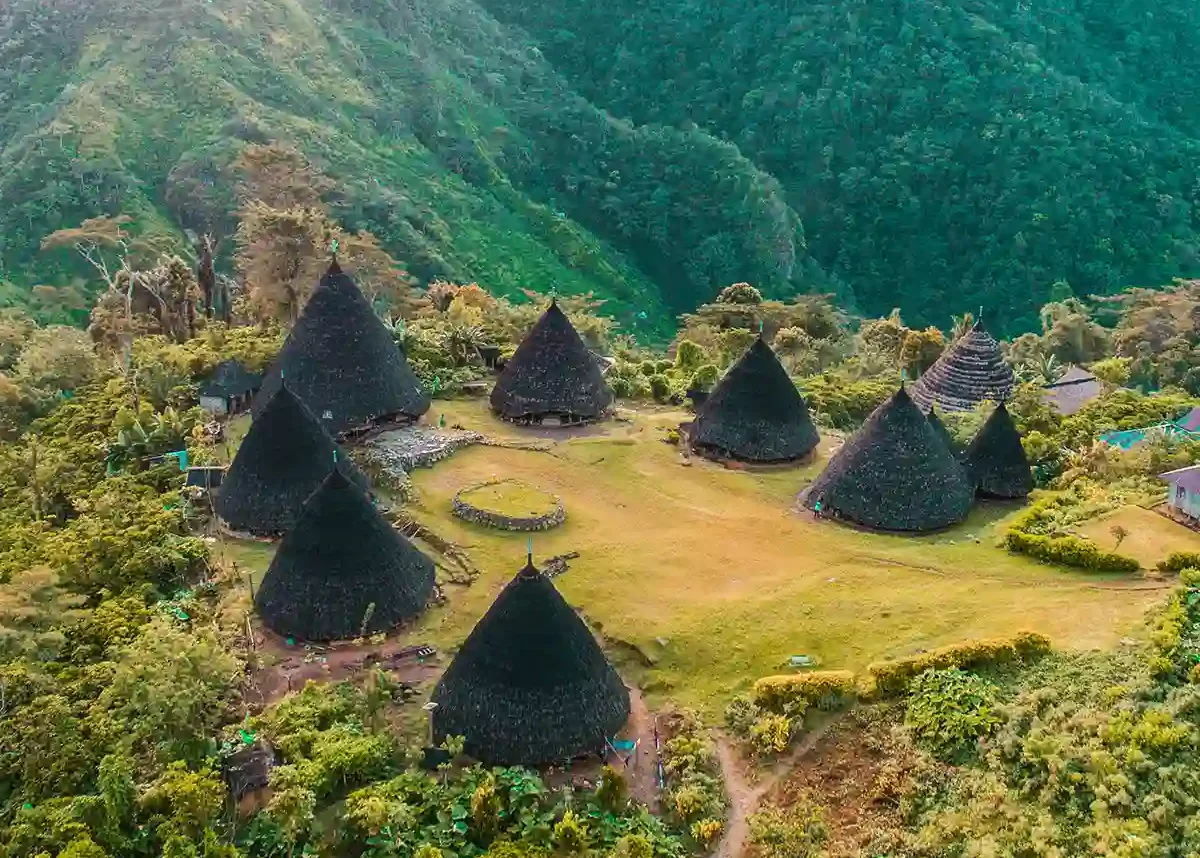
Wae Rebo is a Manggarai traditional village of seven cone-shaped mbaru niang houses, set at about 1,100 m in the mountains of western Flores. Reaching it takes a four-to-five-hour drive from Labuan Bajo plus a guided trek of roughly two and a half hours. We arrange the whole journey privately, door to summit.
There is no road to Wae Rebo, no hotel, and no phone signal once you climb past the second rest post. That isolation is exactly why it has become the most sought-after overnight in Flores: a living village that still raises its great drum houses by hand, receives guests through a ceremony older than the republic, and serves coffee grown on the slopes you just walked. This page covers the drive, the trek, the overnight, the etiquette, and how we build a Wae Rebo tour that is worth the effort it demands.
Wae Rebo in Two Minutes
Wae Rebo is a village of seven traditional drum houses standing in a grass amphitheater ringed by rainforest ridges, reachable only on foot. UNESCO recognized its conservation work with an Asia-Pacific Award for Cultural Heritage Conservation in 2012, and the Wae Rebo traditional village remains a working Manggarai community, not a staged attraction.
The essentials, before we go deeper:
| Fact | Detail |
|---|---|
| Location | Satar Lenda, West Manggarai, western Flores |
| Elevation | About 1,100 m above sea level |
| Houses | 7 mbaru niang (cone-shaped drum houses) |
| Community | Manggarai families, living in the village year-round |
| Access | Trek only, about 5.5–6.5 km from the Denge trailhead |
| Trek time | 2.5–3 hours up, about 2 hours down |
| Recognition | UNESCO Asia-Pacific Heritage Award, 2012 |
| Typical visit | One night in the communal guest house |
Everything about the visit is shaped by that isolation. Supplies climb the same trail you do, guests sleep the way the village sleeps, and the reward is a dawn that photographs cannot fully carry: mist filling the valley below while the seven cones catch the first light.
Getting There: Labuan Bajo → Denge Trailhead
How to get to Wae Rebo starts with a drive of roughly 105–140 km from Labuan Bajo to Denge, the last village with road access, taking four to five hours in the dry season. The final stretch beyond the Trans-Flores Highway is narrow and rough, which is why we use a private car with an experienced Flores driver.
There are two road approaches. The inland route runs east on the Trans-Flores Highway before dropping south toward the coast; the southern coastal road passes rice terraces and the sea at Dintor, with Mules Island offshore, and is the more scenic final hour. Most private itineraries drive out one way and return the other.
| Stage | Distance / time | Notes |
|---|---|---|
| Labuan Bajo → south-coast turnoff | ±3 hours | Sealed Trans-Flores Highway, highland switchbacks |
| Turnoff → Dintor → Denge | ±1–1.5 hours | Narrow coastal and village road, rough in sections |
| Denge → Wae Lomba car park | Short drive or 45-minute walk | Where the forest trail properly begins |
As a component, a private Toyota Innova with driver runs IDR 1.500.000 per day, and we position the vehicle so it is waiting when you descend. Public options exist, but they turn a two-day journey into three and leave the trek timing to chance, which is the one thing worth controlling here.
The Trek: Distance, Difficulty, What to Expect
The Wae Rebo hike covers about 5.5–6.5 km one way with roughly 700 m of climbing, taking most walkers 2.5–3 hours up and around 2 hours down. It is a steady, honest mountain walk under forest shade, moderate for anyone with reasonable fitness, and slippery after rain.
The trail is broken by three rest posts. Pos 1 at Wae Lomba marks the start of the sustained climb through dense rainforest, where the air cools and cicadas take over from village sounds. Pos 2, Poco Roko, is the last point with a trace of phone signal, a fact the village asks guides to mention so guests arrive present. From Pos 3 the path levels, turns a shoulder of the ridge, and delivers the view every trekker walks for: seven cones in a green bowl, often floating above cloud.
Wear proper walking shoes with grip, carry a liter of water per person, and start early. The forest holds its cool until mid-morning, and an early start on the Wae Rebo village trek means you climb in shade and reach the village before the light flattens. Our guides set an unhurried pace with photo stops; this is not a race, and the trail rewards walkers who look up from their feet.
Overnight in a Mbaru Niang
Guests sleep in a communal guest mbaru niang on mattresses and mats arranged around the central hearth space, with blankets provided and meals cooked by village families. The village sets an overnight contribution of around IDR 350.000 per person, which covers the welcome ceremony, dinner, breakfast and your bed.
It is simple, and it is the point. Dinner is Manggarai home cooking, vegetables from the gardens below, rice, and Flores coffee roasted in the village. After dark the amphitheater goes fully quiet, the generator rests, and the sky over the cones is as dense with stars as anywhere in Indonesia. Sleep comes early because dawn is the main event: guests step out before six to watch mist pour through the valley while the houses steam in first light.
A day visit without the overnight is possible, with a smaller contribution set by the village, but it means trekking up and down in the same hours as every other day visitor and missing the two moments, dusk and dawn, that make Wae Rebo more than a photograph. If your knees can carry you up the hill, stay the night.
The Luxury Route: Private Driver, Porters & Comfort Basecamp
No vehicle, and no amount of budget, will change how you reach Wae Rebo: everyone walks. What we refine is everything around the walk, so the trek is the only demanding part of the journey and the timing is always yours.
Our version runs like this. You leave Labuan Bajo the afternoon before with a private driver-guide, take the coastal road while the light is good, and sleep at a comfort basecamp, the best available guesthouse near Denge and Dintor, with a proper bed and an early breakfast arranged. You start the trail at first light, hours ahead of day-trip groups that left Labuan Bajo at 4 am and arrive tired. Village porters, around IDR 150.000 each way, carry your overnight bag, so you climb with a daypack. After the ceremony, the coffee and the night in the drum house, you descend to a waiting car, a cold towel and a packed lunch, then ride the scenic road back, or continue east along the Trans-Flores.
Every departure is private and tailored. Tell us your dates and fitness level on WhatsApp at +62 811 3823 875 or by email at [email protected], and a complete plan comes back within 24 hours.
Etiquette & the Welcome Ceremony
Every guest is formally received in the main drum house through the Wae Lu’u welcome ceremony, in which an elder presents you to the village ancestors and asks for your protection during the stay. The ceremonial fee is around IDR 50.000 per person, and no photography is appropriate until the ceremony is complete.
The rest is straightforward respect, and your guide will walk you through it. Dress modestly on arrival; shoulders covered reads as courtesy here. Ask before photographing people, especially elders and children, and expect a warm yes far more often than not. Drones need the village’s permission before they fly. If you want to give something back, do it through what the village actually sells: hand-woven textiles and some of the best small-lot coffee in Flores, bought directly from the families who made them. Wae Rebo has managed its own tourism carefully for over a decade, and guests who follow its rhythm, rather than imposing their own, are the reason it still works.
Best Time to Trek
The dry season from April to October is the reliable window for the Wae Rebo trek, with May to September the most settled months. From November to March the trail turns slippery and cloud can sit on the village all day.
Two details matter more than the season headline. First, June and July nights are genuinely cold at 1,100 m, so pack a warm layer for the evening in the amphitheater. Second, the famous mist is not a bad-weather sign: even in the dry season the clouds rise and fall through the day, which is precisely what earns the village its name. Trek up in morning shade, and let the afternoon do what it likes. For how Wae Rebo fits the island-wide picture, our month-by-month best time to visit Flores guide covers sea and land conditions together.
Wae Rebo Tours & Prices
There are three ways to build a Wae Rebo tour: a dedicated two-day trip from Labuan Bajo, a one-day extension on the Trans-Flores route, or a stage inside a full overland journey. All are private, and all are quoted individually within 24 hours.
| Option | Duration | How it works | Pricing basis |
|---|---|---|---|
| Wae Rebo 2D1N | 2 days, 1 night | Private car from Labuan Bajo, basecamp night or village night, guided trek | Stage from IDR 3.000.000 + village contribution |
| Trans-Flores extension | +1 day | Added to the Labuan Bajo–Maumere route between Ruteng stages | Quoted within the route itinerary |
| Full overland stage | Inside 7 days | Day 2–3 of the grand overland journey across Flores | Quoted within the full journey |
The 2D1N stage from IDR 3.000.000 covers the private vehicle and logistics; the village contribution, ceremony fee and porters are paid locally at the rates above, and we brief you on exact amounts before departure so nothing on the mountain is a surprise. If you are already planning the bigger island crossing, Wae Rebo slots naturally into our Labuan Bajo to Maumere route as a one-day extension, or anchors the seven-day version of our private Flores overland tour. For something built entirely around you, sea days included, start from our tailor-made Flores journeys.
Every itinerary is arranged by Flores Luxury and operated with our sister company Komodo Luxury, rated 4.9/5 by more than 1,500 verified guests and named Tripadvisor Travelers’ Choice 2025 & 2026.
Plan Your Wae Rebo Trek
Send your dates, group size and how you would like to combine Wae Rebo with the rest of Flores, and we will return a complete private itinerary and tailored quote within 24 hours. WhatsApp +62 811 3823 875 or email [email protected]. The village has been welcoming guests the same way for generations; the only thing it asks is that you walk.
Frequently Asked Questions
How do you get to Wae Rebo from Labuan Bajo?
Drive roughly 105–140 km, four to five hours, to Denge, the last village with road access, then trek about 5.5–6.5 km uphill for 2.5–3 hours. There is no road to the village itself. We run it as a private 2D1N trip with a driver-guide, an overnight near the trailhead, and an early-morning trek ahead of the day-trip crowds.
How hard is the Wae Rebo hike?
Moderate. It is a steady climb of about 700 m over 5.5–6.5 km, almost entirely shaded by rainforest, with three rest posts along the way. Most reasonably fit walkers reach the village in 2.5–3 hours and descend in about 2. The trail is well-trodden but slippery after rain, so proper walking shoes with grip are essential.
How much does a Wae Rebo tour cost?
Our private 2D1N stage from Labuan Bajo starts from IDR 3.000.000, covering vehicle and logistics. Paid locally on top: the village overnight contribution of around IDR 350.000 per person including ceremony, meals and your bed, the Wae Lu'u ceremony fee of around IDR 50.000, and optional porters at about IDR 150.000 each way. A complete tailored quote arrives within 24 hours via WhatsApp.
Can you visit Wae Rebo without staying overnight?
Yes, a day visit is possible with a smaller contribution set by the village, but it means climbing and descending in the busiest hours and missing dusk and dawn, which are the two finest moments in the amphitheater. If your schedule and fitness allow, the overnight in a mbaru niang guest house is what makes Wae Rebo worth the trek.
What is it like sleeping in the village, and what should I pack?
Guests share a communal drum house with mattresses, mats and blankets around the central space; dinner and breakfast are cooked by village families. Pack light: a warm layer for cold nights, especially June and July, walking shoes, a rain shell, a headlamp, and cash for the village fees and for coffee or woven textiles. Porters can carry your overnight bag up the mountain.
Do you need a guide for the Wae Rebo village trek?
Treat a local guide as part of the visit. The village expects guests to arrive accompanied, the guide handles your registration and the welcome ceremony, and the fee stays in the community. On our tours the trekking guide and porters are arranged in advance alongside your driver, so the whole chain from Labuan Bajo to the village runs on one plan.
Is Wae Rebo suitable for children or older travelers?
Children who can walk three hours uphill manage it well, and we regularly arrange the trek for travelers in their sixties and beyond, with porters, an unhurried pace and the basecamp night to shorten the summit day. The honest limit is the trail itself: there is no vehicle access and no shortcut, so every visitor must be able to walk both directions.
Why is Wae Rebo called a traditional village?
Wae Rebo is one of the last Manggarai communities still living in mbaru niang, the great cone-shaped drum houses rebuilt by hand using original techniques. Seven houses stand in the mountain amphitheater, families live in them year-round, and the village's conservation of the tradition earned a UNESCO Asia-Pacific Heritage Award in 2012. It is a living village that receives guests, not a museum.