

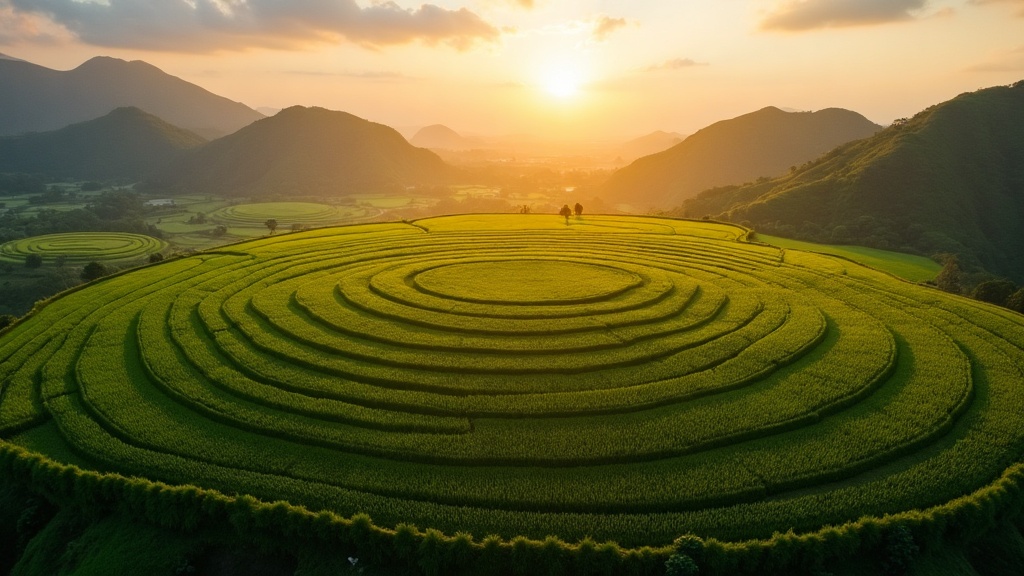
The spider web rice fields of Cancar are giant circular paddies, divided like wheel spokes under the Manggarai lingko system, 17 kilometers west of Ruteng in the Flores highlands. You view them from a hilltop above Cancar village — ideally as the Day 1 highlight of a private Trans-Flores journey.
Ruteng itself is the cool, Catholic, coffee-growing capital of Manggarai, sitting above 1,000 meters where the air turns crisp after the heat of the coast. Most travelers meet it as their first night on the road east from Labuan Bajo, and the webs of Cancar are the reason to arrive with daylight to spare. This guide explains how the circles came to be, how the viewpoint visit actually works, which months color the fields, and what else around Ruteng deserves a place on your itinerary.
Why the Rice Fields of Cancar Look Like Spider Webs
The webs are not decoration; they are land law drawn in rice. Each circle is a lingko — a communal field owned by a clan and divided from a single center point outward, so the shape you photograph is a living map of who farms what.
At the heart of every circle stands the lodok, the ceremonial center marked by a wooden post where offerings are made before the land is worked. From that point, elders divide the field like slices of a cake: each family’s share is measured in moso — finger-widths at the center pole — and widens as the boundary lines radiate to the rim. A larger allocation at the center means a wider wedge at the edge, so status, family size and adat obligations are all legible in the pattern. The result, repeated across the valley, is a cluster of vast green spider webs — and unlike a monument, they are worked every season: buffalo in the mud, planting lines of farmers, smoke from the field huts. Similar lingko exist across Manggarai, but nowhere are they as large, as concentrated or as perfectly viewable as at Cancar.
Ruteng: The Cool Highland Capital of Manggarai
Ruteng is the administrative and spiritual center of the Manggarai people — a tidy grid of tin roofs, seminaries and coffee warehouses ringed by rice terraces and volcano ridges. After Labuan Bajo’s harbor heat, its cool evenings are the first sign you have entered a different Flores.
| Ruteng at a glance | Detail |
|---|---|
| Elevation | ±1,100 m — bring a layer for evenings |
| Region | Manggarai, western Flores highlands |
| From Labuan Bajo | ±130 km, 4–5 h on the Trans-Flores Highway |
| Known for | Cancar lingko fields, Liang Bua cave, cathedral, arabica coffee |
| Role on the route | Night 1 of the west-to-east Trans-Flores crossing |
The town rewards a slow evening more than a checklist: the cathedral square at dusk, grilled corn from the night stalls, and highland arabica grown on the surrounding slopes and served strong and sweet. Ruteng is not a resort town and does not pretend to be one — its best rooms are boutique guesthouses and convent-run lodgings that are clean, quiet and genuinely warm, which is exactly what a travel day on mountain switchbacks calls for.
Visiting the Cancar Viewpoint
The viewing hill sits behind Cancar village, about 17 kilometers west of Ruteng — a 30–40 minute drive. From the parking area it is a short, stepped climb of around 15–20 minutes to the terraces cut into the hillside, each level opening a wider view of the circles below.
The visit is refreshingly informal. You stop first at the caretaker family’s house at the base to sign the guestbook and leave a small cash donation — there is no formal ticket gate, so carry small notes. On the hill, three natural terraces face slightly different angles of the valley; the highest one lets you count several complete webs at once. Morning light is the photographer’s choice, with the circles crisp and the ridgelines clear before the midday haze builds; late afternoon is softer and quieter. Allow about an hour on site. Because the fields lie west of town on the Labuan Bajo road, westbound travelers usually visit before checking in at Ruteng, and eastbound travelers stop on the way out — either works, and a good driver-guide will time it around the light.
Best Season to See the Lingko Fields
The geometry reads year-round — the web is carved into the land, not painted on it — but the colors change with the rice cycle. The highlands follow the wet season, so the calendar below is a reliable guide rather than a guarantee.
| Months | What the circles look like |
|---|---|
| November–January | Planting: flooded paddies mirror the sky, fresh seedlings trace the spokes |
| February–March | Growing: the webs at their deepest, most photogenic green |
| April–June | Ripening and harvest: green turns to gold wedge by wedge |
| July–October | Dry season: stubble and earth tones, but the clearest skies and sharpest lines |
There is no bad month, only different photographs. If the fields are your priority, aim for February to April, when green or gold fills the circles; if you are crossing Flores in the driest months for the sake of the sea days, the pattern is still unmistakable — and you will likely have the hill to yourself.
Ruteng Tours & Things to Do Nearby
A Ruteng tour is really a half-day loop of short drives, with Cancar as the headline and three or four supporting acts. Everything below is reachable with the same car and driver that brought you across the island.
| Sight | Why go | From Ruteng |
|---|---|---|
| Cancar spider web fields | The lingko viewpoint itself | ±17 km west, 30–40 min |
| Liang Bua cave | Excavation site of Homo floresiensis, the “hobbit” unearthed in 2003 | ±14 km north, 40 min |
| Ruteng Pu’u | Traditional Manggarai compound village with ancestral drum house | In town |
| Golo Curu hill | Sunrise viewpoint over the town, terraces and ridgelines | ±2 km north |
| Coffee country | Highland arabica and robusta — tastings arranged on request | Slopes around town |
Liang Bua deserves more attention than it gets: the airy limestone cave where archaeologists uncovered a meter-tall human species changed the story of our genus, and you will often have the site and its small museum almost to yourself. Combined with Cancar and an evening in town, it turns Ruteng from a road stop into one of the most quietly interesting days on Flores.
Plan Your Ruteng & Cancar Stop
Tell us your dates and travel style and we will build Cancar, Liang Bua and the right Ruteng boutique stay into a private itinerary, with a tailored quote within 24 hours. WhatsApp +62 811 3823 875 or email [email protected].
Getting to Ruteng
Nearly everyone arrives by road. From Labuan Bajo the Trans-Flores Highway climbs ±130 kilometers of paved switchbacks in four to five hours — a genuinely scenic half day, not a transfer to endure — and from Bajawa in the east the drive is similar.
The comfortable way to do it is a private car with an English-speaking driver-guide: a Toyota Innova with driver runs IDR 1.500.000 per day, and a Hiace with driver (groups) IDR 2.500.000 per day for overland stages, with fuel and the driver’s costs included in our quotes. Public buses and shared cars cover the same road for less, but they leave when full, stop where they choose and turn the best viewpoints into window glimpses. Ruteng’s small airfield sees only intermittent schedules, so the road is not just the practical choice — it is the point.
Where Ruteng Fits in a Luxury Flores Journey
Ruteng is Night 1 of the classic west-to-east crossing — the natural pause between the harbor and the higher country beyond. On our six-day Labuan Bajo to Maumere luxury overland, Day 1 ends here with the Cancar webs already behind you and Bajawa’s volcanoes ahead.
Travelers with more time treat Ruteng as a hinge rather than a stop. Our private Flores overland tours pair it with Bajawa, Riung and Kelimutu over five to seven days, and the most requested add-on begins right here: the Wae Rebo village trek, an overnight in the cone-roofed cloud village reached via Denge south of Ruteng — the 2D1N extension runs IDR 3.000.000 for the private vehicle and logistics, plus village contributions paid locally. However you combine them, every journey is private, built around your dates, and priced as a single transparent quote.
Start Planning
Send your travel window and party size and a day-by-day Flores route — with Ruteng, Cancar and real hotel names — will be with you within 24 hours. WhatsApp +62 811 3823 875 or email [email protected].
Frequently Asked Questions
What are the spider web rice fields of Cancar?
They are large circular communal rice fields near Cancar village, 17 kilometers west of Ruteng in western Flores, divided under the Manggarai lingko system. Each family's share is measured in finger-widths (moso) at a central ceremonial point (lodok) and widens toward the rim, producing the spider-web pattern seen from the hilltop viewpoint.
How do you get to the Cancar viewpoint?
Drive 30-40 minutes west of Ruteng on the Trans-Flores road toward Labuan Bajo, park at Cancar village, then climb a stepped path for about 15-20 minutes to terraced viewpoints on the hill. Coming from Labuan Bajo, the fields sit just off your route, so most travelers visit on arrival day before checking in at Ruteng.
Is there an entrance fee for the spider web rice fields?
There is no formal ticket gate. Visitors sign a guestbook at the caretaker family's house at the base of the hill and leave a small cash donation, so carry small notes. On our private journeys the driver-guide handles the stop and the courtesy.
When are the Cancar rice fields at their greenest?
Roughly February to March, when the planted rice is at full growth; April to June turns the circles gold before harvest. In the November-January planting window the flooded paddies mirror the sky, and in the July-October dry season you get earth tones with the clearest skies. The web pattern itself is visible all year.
Is Ruteng worth staying overnight?
Yes – it is the natural first night of any west-to-east Flores road journey, about 4-5 hours from Labuan Bajo. An overnight lets you pair the Cancar viewpoint with Liang Bua cave, where Homo floresiensis was unearthed in 2003, and enjoy the cool highland evening rather than racing on to Bajawa in the dark.
Can you combine Ruteng with the Wae Rebo trek?
Yes. The Wae Rebo trailhead at Denge lies south of the Ruteng region, and the 2D1N extension – private vehicle and logistics from IDR 3.000.000, plus village contributions paid locally – slots naturally after your Ruteng night. It adds one day to a Trans-Flores itinerary and is the most requested addition on the route.
Keep Reading
Uncategorized
Flores to Komodo Route Planning: Luxury Charter Guide 2026
The most efficient luxury route into Komodo runs through Labuan Bajo's Komodo Airport: fly in via Jakarta or Bali, sleep…

Uncategorized
Honeymoon in Flores & Komodo: Private and Secluded
A honeymoon in Flores and Komodo means a private phinisi with its own crew and chef, empty pink-sand beaches, Komodo…

Uncategorized
Getting to Labuan Bajo from Bali, Jakarta & Beyond
The fastest way to get to Labuan Bajo is a direct flight into Komodo Airport: about 90 minutes from Bali,…